We both slept poorly again, so dragged ourselves and our small appetites down from breakfast. E had pastries and toast while I opted for (thick) porridge with honey and a strawberry compote (which I ate around) for breakfast. While eating the fire alarm went off and whooped for about 15-20 seconds – “the basement is NOT on fire” our waitress assured us. Well that’s nice to hear.
After breakfast we packed up again and drove to Richmond where we found street parking that, coincidentally and appropriately, was directly in front of the Richmond Theatrical Society offices. From there we walked the short distance over to Georgian Theatre Royal where we found ourselves with a private tour of the theater. Was kind of funny to hear the operators having the same challenges as any other theater company – we shared some of our experiences with our guide. When we finished there were a half dozen folks in the lobby who had arrived to take the tour immediately after ours.
Our curiosity fulfilled, we then drove to Durham, making a stop at a Services turnoff along the way to add about 11L gas (about 2.5 gallons). We decided to do this on the way since the quick on/quick off access of the motorway services would be easier to navigate than trying to fill up at a station in Durham.
Pre-trip planning really paid off for Durham. In late June I realized that our plan for the Castle and/or Cathedral required parking in a place where there’s, frankly, no parking. Darn those tiny little medieval lanes! So I quickly reviewed their websites and concluded that the best solution was to use Durham’s Park and Ride system which is designed for just this issue. Basically, the city runs three different parking sites, one of which (the delightfully-named Sniperly Park and Ride) was very close to The Kingsbridge Inn, where we were planning to stay while overnight in Durham. So we’d park the car upon arriving in Durham, grab the bus that ran every 15 minutes, and make the short ride to be dropped off at Durham Market Square at the north end of the peninsula where the good stuff was. We’d have about a 10 minute walk to the Cathedral, but since we’d be getting to the area around lunchtime it was a good excuse to stop at Bell’s Fish Shop for our only (officially) scheduled F&C luncheon.
Got into Durham and drove straight to the park and ride where we caught one of the buses into the central core of Durham. From there we walked to Bells. At Bell’s we had a choice between restaurant and takeout…uh, I mean takeaway. Since we’re now old farts we decided for the more sedate pace of a sit-down restaurant. While waiting for our food I pulled out my phone and purchased tickets to a guided tour of the cathedral, as we’d realized from our experiences at York that having a guide made the experience so much more rewarding. Our food was quickly delivered (Cod for E and haddock for me) and we had more than enough time to eat, pay, and make the short walk to Durham Cathedral, arriving about 20 minutes before the tour was scheduled to start.
We slowly walked around for about 10 minutes before deciding to make a bathroom stop, after which we joined our tour group. Oddly, we were never asked to show proof that we had purchased tickets. This was another excellent tour. They were quite busy – there were at least 2 other tours running concurrent with ours, including one that was obviously a bunch of school kids on an outing.
During the tour the guide happened to make a passing comment that implied that student housing at Durham College was a challenge for everyone. It happened to be an Open House for students on the day we were there – or perhaps it was move in day? We weren’t sure. But it was an interesting thought to wonder how housing was handled.
Anyway, we eventually made our way back to pick up the bus that would return us to the park and ride to get our car. Lots of traffic. While it was only about 330P we think it might have been the start of local rush hour. Retrieving the car, we drove over to Kingslodge Inn, missing one turn but not a big deal. Big onsite car park. Checked in at bar and get key to room 8 – again! We were in room 8 last night at the Royal Oak Hotel in Ripon, too.
We reviewed our various dinner choice and confirmed that we were OK with the ½ mile walk and eventually set off for dinner at Gusstos, crossing the river. There was an Interesting water feature we saw from the bridge – it seemed more decorative than functional, although who knows?. Since we were a few minutes early we walked a (very) short distance past restaurant to the end of block and were amazed to discover we were back at where the park and ride bus had dropped us off for the cathedral! No idea we were THAT close! Dinner, consisting of several tapas choices, was good but not great – but we remained happy with our choices.
Post-dinner we popped into a Tesco Express store that was next door and bought two varieties of biscuits to take back to the room with us. E got some kind of Lemon Ginger sandwich cookie while I got milk chocolate covered sugar cookies. As we were walking out of the central dining street where we’ve just eaten we were struck by how dark it is. Another US/UK diff – in the US this whole street would have been brightly lit and all the restaurants would have been spilling light onto the street, even if subdued. Here, if you aren’t paying attention you could easily think your restaurant is closed.
After breakfast we packed up again and drove to Richmond where we found street parking that, coincidentally and appropriately, was directly in front of the Richmond Theatrical Society offices. From there we walked the short distance over to Georgian Theatre Royal where we found ourselves with a private tour of the theater. Was kind of funny to hear the operators having the same challenges as any other theater company – we shared some of our experiences with our guide. When we finished there were a half dozen folks in the lobby who had arrived to take the tour immediately after ours.
 |
| A recreation of the original footlights at the theater. These candles would be placed in bowls of water to enhance the illumination via reflectivity and then hoisted up to stage level. The (tiny) orchestra pit is on the other side of this. Out of view, just to the left of the guide, was the working trap door elevator used to lift an actor up through the stage floor. In design and construction it was almost a exact copy of the elevator Hal Stephens built for our Iolanthe of so many years ago. |
 |
| The oldest known surviving scenic elements in the UK. These small (about 2' wide by ~7' tall) beautifully painted flats would be slotted into wooden tracks on either side of the stage and could be slid in/out of view for scene changes. There were 4 tracks (still present), each with three slots, located OSL and OSR of the stage, allowing for up to 12 different scenes to be preset. |
 |
| The backdrop corresponding to the flats. |
Pre-trip planning really paid off for Durham. In late June I realized that our plan for the Castle and/or Cathedral required parking in a place where there’s, frankly, no parking. Darn those tiny little medieval lanes! So I quickly reviewed their websites and concluded that the best solution was to use Durham’s Park and Ride system which is designed for just this issue. Basically, the city runs three different parking sites, one of which (the delightfully-named Sniperly Park and Ride) was very close to The Kingsbridge Inn, where we were planning to stay while overnight in Durham. So we’d park the car upon arriving in Durham, grab the bus that ran every 15 minutes, and make the short ride to be dropped off at Durham Market Square at the north end of the peninsula where the good stuff was. We’d have about a 10 minute walk to the Cathedral, but since we’d be getting to the area around lunchtime it was a good excuse to stop at Bell’s Fish Shop for our only (officially) scheduled F&C luncheon.
 |
| Some of the statues of Durham Market Square, as we're walking to lunch at Bells Fish. The closer statue is Neptune, while the horse and rider is of Charles Vane. Yeah, I don't know who that was, either. |
 |
| The building labeled "Town Hall" is apparently the town hall. See how I'm using context cues to draw conclusions as to what is around us? |
 |
| A closer look at Charles Vane. I assume he's the dude, but maybe he's the horse? |
 |
| Heading toward the Cathedral (and College) after lunch. Even on this narrow street there were a small number of cars working through the crowds. |
 |
| As we got closer the street got a bit narrower and the slope got a tiny bit steeper. Although a lot of umbrellas are in view, the "rain" was no more than a few drops. It was mostly just a constant "damp" rather than "rain". This was pretty consistent weather throughout the trip. Although we had our 3-in-1 jackets we most commonly used just the rain shell as it wasn't 100% necessary to use the fleece, too. I wore my fleece mostly because it was easier than carrying it, not because I really needed it. |
 |
| The view as we approached the Cathedral. One of the main College buildings is off to the right. There was some kind of Open House event going on today for the College. We're not sure if it was for prospective students to see the place or it was move-in day for the current term, but we did see a small handful of meeters and greeters at various locations we passed. It is next to impossible to tell what functions different buildings had - we might have been passing lecture halls, dorms, offices, or apartments. It just wasn't clear to us. |
 |
| About to enter the Cathedral. It is about 110P and we have a ticket for a tour that is slated to start at 130P. |
 |
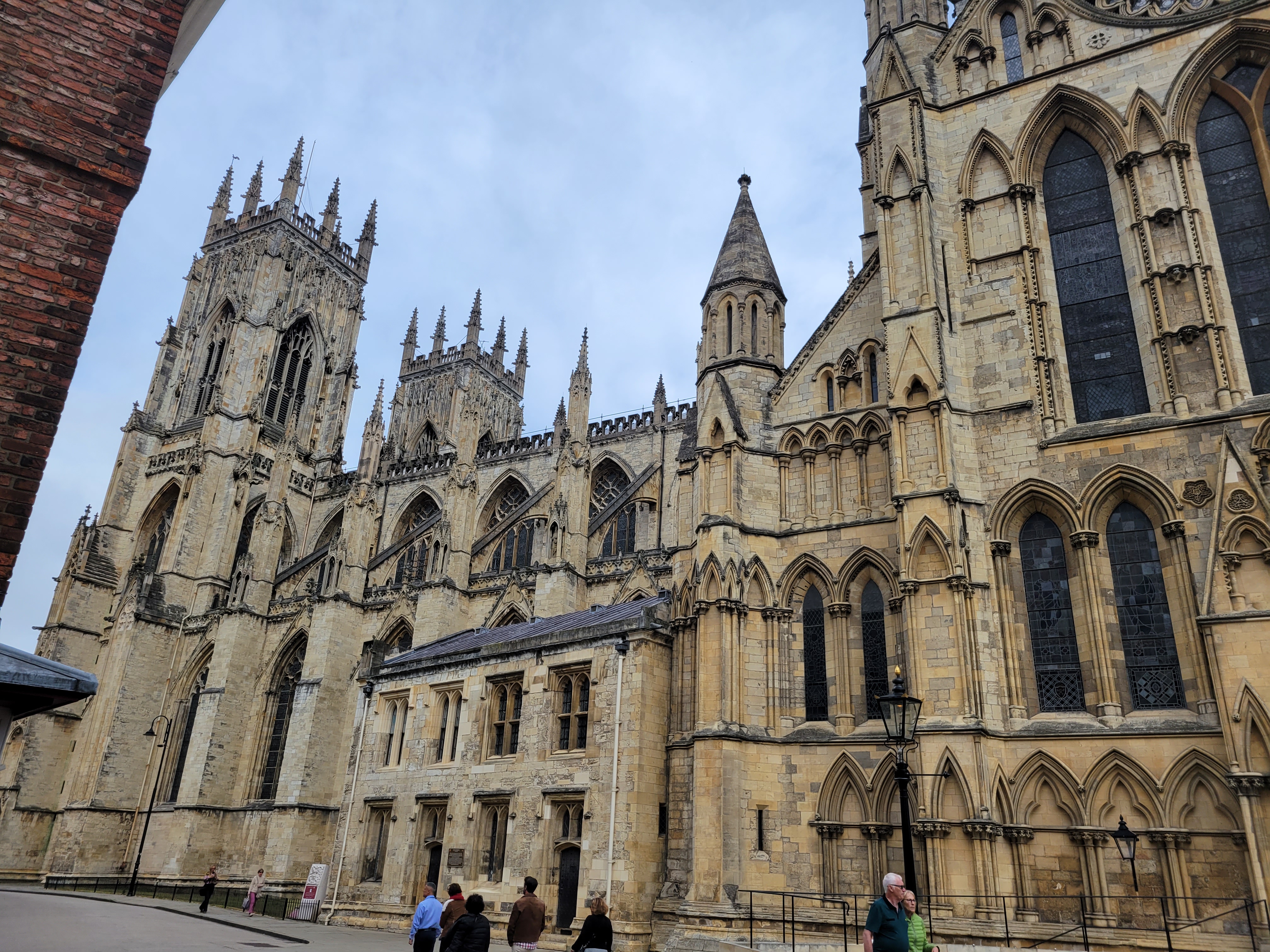
| I don't recall what this was a picture of. Since we haven't yet gone into the Cathedral it is possible that I spun around and took a picture of the College, or this is some other corner of the Cathedral. |
During the tour the guide happened to make a passing comment that implied that student housing at Durham College was a challenge for everyone. It happened to be an Open House for students on the day we were there – or perhaps it was move in day? We weren’t sure. But it was an interesting thought to wonder how housing was handled.
 |
| We wandered a bit aimlessly in the 15 minutes prior to our tour, so this was a pretty window that I have no information about. |
 |
| There were a lot of people milling about, but I wouldn't call the Cathedral "crowded". By going in mid-September we managed to avoid a lot of the tourist crush. Nice! |
 |
| Several of the columns at Durham have simple geometric designs in them. These were apparently carved at the quarry, and then shipped to the cathedral for reassembly onsite. The guide mentioned that a builder had told her that this meant there was a whole lot of waste material that they did not have to deal with at the building site - all the debris would have been left at the quarry. |
 |
| There was a significant development in building mechanics during the construction, which can (barely) be seen here. The oldest arches in the church, seen on the right side of the photo in the foreground, are rounded Roman arches with their carved tracery. Just beyond that, on the other side of the decorated column, is a newer Norman arch, which comes to a peak. Norman arches can support more weight than Roman arches and are what allowed for things like vaulted roofs. From context clues such as these historians and archaeologists can pinpoint when various parts of the building were built. |
 |
| A memorial found in a random aisle. Everywhere you go you see (at least) a memorial to World War I, and most places have multiple memorials. |
 |
| Prior Castel's clock, the only wooden object known to have survived the Civil War. The building was used by Cromwell to house Scottish POWs, who burned most things for warmth. The story (most likely apocryphal) is that Scots didn't burn the clock because there's a large carved (Scottish) thistle adorning the top of it. In all likelihood the clock was probably hidden in storage. The clock originally had only a single hand, which is why there are only 3 divisions between each number. The hand would indicate x:00, x:15, x:30, and x:45 rather than individual minute intervals. |
 |
| Part of the pipes for the great organ. There are apparently more than 4600 pipes. |
 |
| We're about to enter into the tomb of St Cuthbert. The wall plaques list all the church officials through history. Thomas Wolsey's name makes a surprise appearance - he was Bishop here during the days of Henry VIII, although he apparently never visited. |
 |
| The grave of St Cuthbert. The statue depicts St Cuthbert holding St Oswald's head. Oswald's head was, indeed, buried alongside Cuthbert. Cuthbert's statue lost its own head during the Civil War, when it was sawed off. |
 |
| This is the newest window. It was installed in 2019 as a memorial to a university student who had died unexpectedly. |
 |
| The tomb of the Venerable Bede. Bede had no real association with Durham, having been a monk from Jarrow. However, in about 1000 a Durham-based monk was determined to bring as many notable Northumbrians to Durham as possible. He visited Jarrow and essentially stole Bede's remains from there. |
 |
| In tribute and memorium to the Durham Light Infantry |
 |
| A better view of Neptune, taken on our way back to the park and ride bus stop |
 |
| Relaxing in our room at The Kingslodge Inn before heading for dinner. We both had our phones and tablets with us. Additionally, I had taken my laptop so I could have easier browser access. This turned out to be a smart choice! |
 |
| Our room |
 |
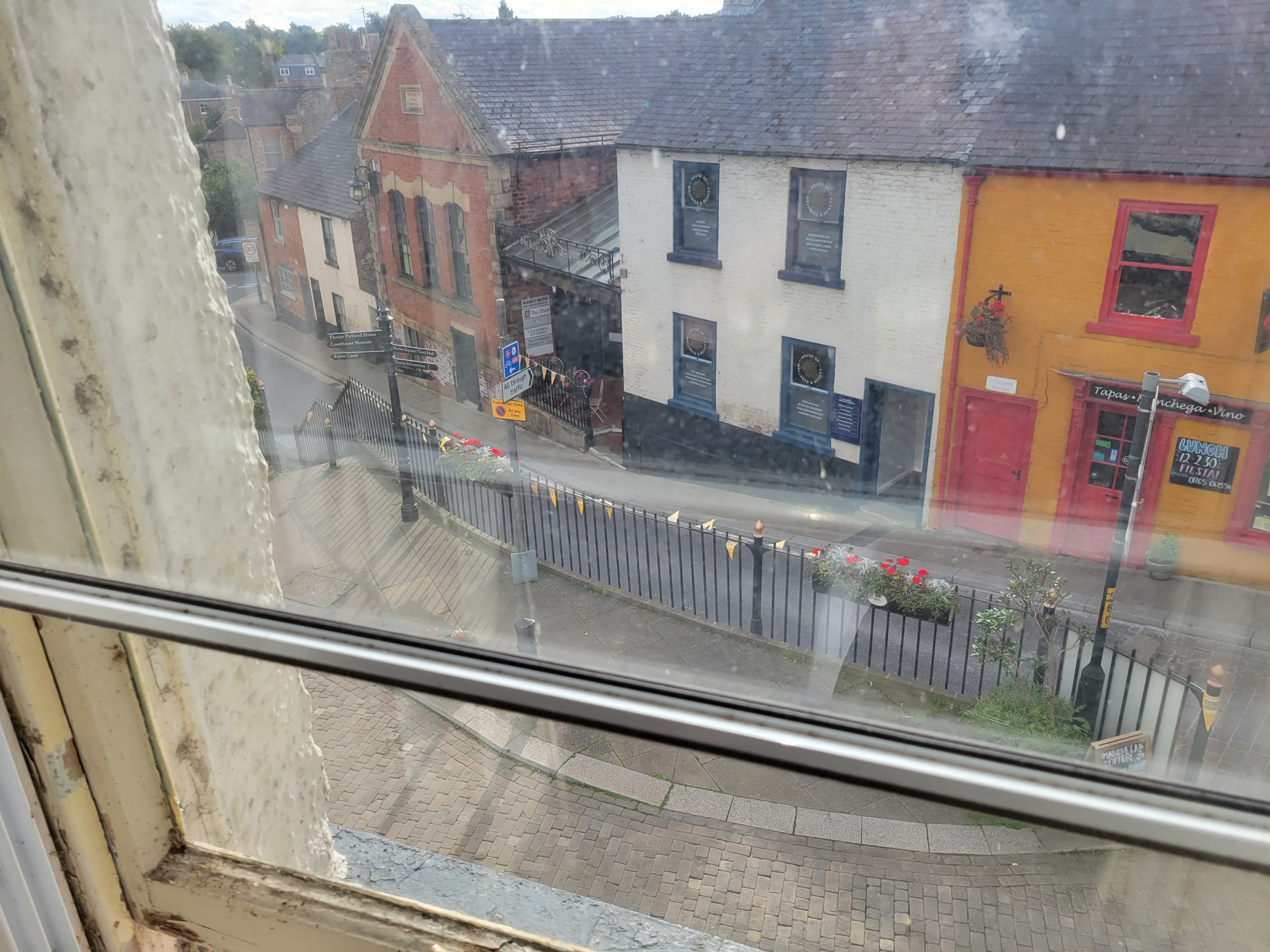
| A view of the car park from our room. This was, by far, the largest onsite car park we had access to. |
Post-dinner we popped into a Tesco Express store that was next door and bought two varieties of biscuits to take back to the room with us. E got some kind of Lemon Ginger sandwich cookie while I got milk chocolate covered sugar cookies. As we were walking out of the central dining street where we’ve just eaten we were struck by how dark it is. Another US/UK diff – in the US this whole street would have been brightly lit and all the restaurants would have been spilling light onto the street, even if subdued. Here, if you aren’t paying attention you could easily think your restaurant is closed.
 |
| A view of (I think) Durham College as we're walking to dinner. For some reason I didn't really have a good sense of the geography of Durham. We were stunned to discover that dinner was just a stone's throw from Market Square - so hadn't really registered the idea that we were walking in the direction of the Castle and Cathedral at this time of the evening. |
 |
| A view from the bridge over the river. Whether or not the water feature back there was functional or purely decorative was unknown. |
 |
| And now here's the Cathedral peeking over the ridge as we're walking to dinner. Once again, it isn't registering on my brain that our walk is taking us right back to where we'd spent the afternoon. |
 |
| And here was are, post-dinner, having just come out of the Tesco store that was next to the restaurant, and realizing that we're on the other side of Durham Market Square compared to earlier in the day. The Durham Town Council is just to the left of that tower. We couldn't believe how close Kinglodge Inn was to this place! |